
Table of Contents
- Start With a Measured, Drawer-by-Drawer Plan
- How to Declutter Kitchen Drawers Without Regret
- What to Put in Small Kitchen Drawers (and What to Move Out)
- Kitchen Drawer Organizers for Small Spaces: What Actually Fits
- Organizing Kitchen Drawers for Small Items: Cutlery, Spices, and Clutter Magnets
- Solutions for Shallow, Narrow, and Awkward Drawers
- Low-Cost and No-Purchase Ways to Organize Small Kitchen Drawers
- Keep Small Kitchen Drawers Organized: A 10-Minute Reset Routine
- Frequently Asked Questions
Last Updated: October 12, 2026
Start With a Measured, Drawer-by-Drawer Plan
Most people buy organizers first and measure later, which is why so many dividers end up in a donation pile. Learning how to organize small kitchen drawers starts with a tape measure, not a shopping cart.
Measure Every Drawer Before You Buy Anything
Write down width, depth, and height for each drawer, measuring the inside rather than the cabinet front, plus how far it pulls out.
- Width: the left-to-right space inside the drawer box
- Depth: front to back
- Height: from the base to the point where the drawer starts to bind
That last number matters: a deep drawer that only opens halfway hides everything at the back.
Map Each Drawer to a Job
Give every drawer one clear job, the step that separates a lasting system from one that collapses in a month.
A simple mapping method:
| Drawer | Job | Example Contents |
|---|---|---|
| Top, nearest hob | Daily cooking | Spatulas, tongs, wooden spoons |
| Top, near sink | Washing up | Cloths, brushes, gloves |
| Middle | Cutlery | Forks, knives, spoons, teaspoons |
| Lower | Occasional tools | Baking tins, measuring cups, skewers |
| Bottom or deep | Bulk storage | Storage containers, lids, larger tools |
Write the job on a sticky note and tape it inside the drawer. It sounds fussy. It works.
How to Declutter Kitchen Drawers Without Regret
Decluttering kitchen drawers is the step most guides rush. Empty one drawer at a time and sort every item into four piles, and do not let the "purge" pile become a "maybe" pile.
The Four-Pile Method: Sort, Purge, Store, Organize
Here is the full method, in order:
- Sort. Tip the drawer onto a tea towel and wipe it out while empty.
- Purge. Remove anything broken, duplicated, or unused for a year.
- Store. Put back only what belongs in this drawer's job; move the rest to its correct home.
- Organize. Add dividers and trays only after steps one to three.
The order matters: buying organizers before you purge means buying space for things you do not need.
What to Put in Small Kitchen Drawers (and What to Move Out)
Small kitchen drawers work best when they hold flat, light, frequently used items; heavy or bulky tools belong elsewhere.
Good candidates for a drawer:
- Cutlery and flatware
- Cooking utensils you use daily
- Spices and small jars
Move these out of the drawers:
- Stand mixers, blenders, and other heavy appliances
- Large pots, pans, and baking trays
- Bulk dry goods in big bags
A drawer is prime real estate, and heavy items are hard on runners and hard to lift from low.
Kitchen Drawer Organizers for Small Spaces: What Actually Fits
Kitchen drawer organizers for small spaces fall into a few families, each suiting a different drawer shape. Pick by the job, not the photo on the box.
Dividers, Trays, and Tiered Inserts Compared
| Type | Best For | Watch Out For |
|---|---|---|
| Adjustable dividers | Odd widths, changing contents | Can slide if not locked down |
| Fixed trays | Cutlery, standard drawers | Wasted space in non-standard sizes |
| Tiered inserts | Deep drawers, small items | Needs vertical clearance |
| Peg or slot organizers | Plates, lids, awkward shapes | Takes longer to set up |
Adjustable dividers win for most small kitchens because they flex to the drawer you actually have; fixed trays set up faster but only fit standard sizes.
A common mistake is buying a full-width tray for a slightly non-standard drawer: it rattles, shifts, and leaves dead space at the edges.
Organizing Kitchen Drawers for Small Items: Cutlery, Spices, and Clutter Magnets
Small items turn a tidy drawer into a mess: straws, skewers, loose spice packets, and twist ties drift to the back and tangle.
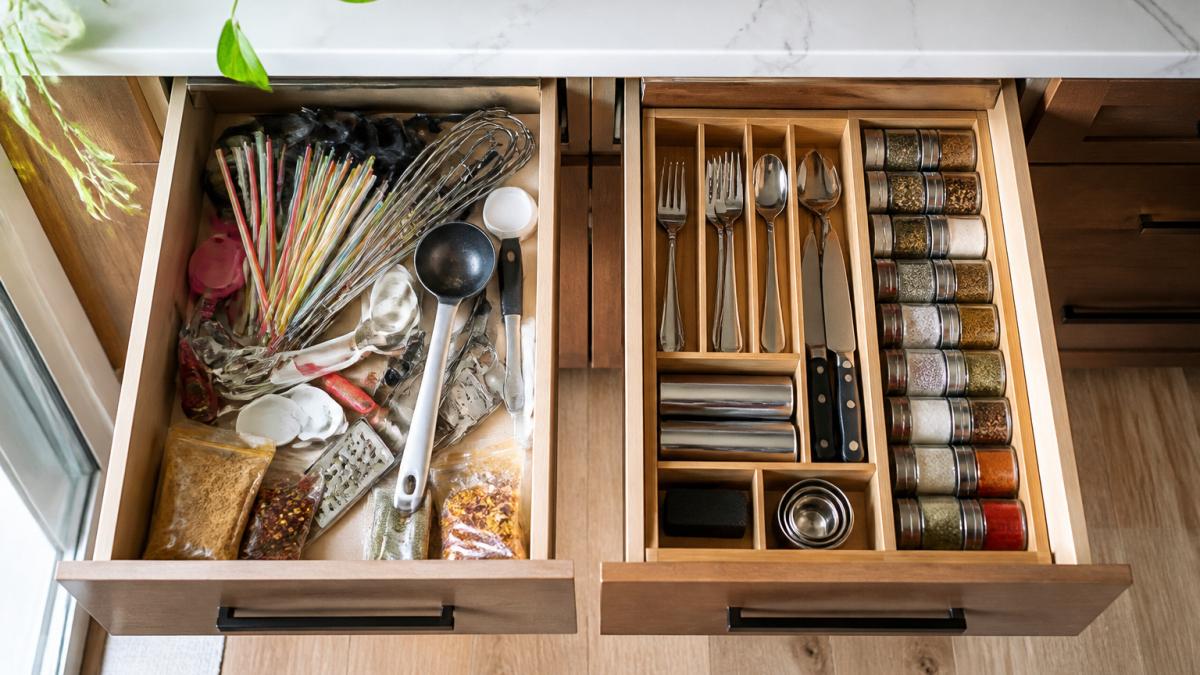
Start with cutlery: a shallow tray with fixed slots keeps forks, knives, and spoons from sliding into a heap.
Then deal with the clutter magnets:
- Straws and skewers: stand them upright in a small cup or narrow insert
- Loose packets: corral them in one small box, not scattered
- Twist ties and clips: one tiny container, lid on
The rule is simple. If an item is smaller than your thumb, it needs a container.
Solutions for Shallow, Narrow, and Awkward Drawers
Awkward drawers are not a lost cause; shallow, narrow, and oddly shaped ones just need a different approach than a standard tray. Shop for that drawer's specific dimensions, not a generic "drawer organizer".
Shallow drawers (roughly 5 cm / 2 in interior height or less)
Skip tiered inserts entirely. They need vertical clearance you do not have, and a stacked tray will either hit the cabinet frame or leave the top layer unusable. Instead:
- Use a single flat layer of dividers. Spring-loaded dividers expanding from about 30 cm to 55 cm (12-22 in) fit most shallow cutlery drawers.
- Look for low-profile trays with a base under 4 cm (1.5 in); many standard trays are 5-6 cm tall and will bind.
- Keep only flat items inside: cutlery, spatulas, peelers, measuring spoons, flat packets.
A useful check: place the tallest item you plan to store in the drawer, close it slowly, and listen. A scrape means it is too tall.
Narrow drawers (roughly 15-25 cm / 6-10 in wide)
A single wide tray wastes most of a narrow drawer because its outer walls eat the usable width. Instead:
- Use two or three slim side-by-side dividers rather than one wide tray. Spring-loaded dividers as narrow as 7-8 cm (3 in) are common.
- A narrow drawer beside the hob is perfect for cooking utensils laid flat, tongs, spatulas, wooden spoons, because you can see every handle at a glance.
- For a drawer under 15 cm (6 in) wide, skip dividers and use a single row of small open-top cups or a cut-down cardboard insert.
Awkward or tapered drawers
Many drawer boxes taper slightly from front to back, and some have a cut-out around the sink or hob. A tray that fits the front edge can jam near the back.
- Measure the drawer at its narrowest point, not its widest.
- Use adjustable dividers you can trim or reposition; some sets include removable sections to shape the layout.
- For a drawer with a cut-out, treat the cut-out as a separate zone: a small cup or box in the deep section, dividers in the shallow section.
Very deep drawers
A deep drawer is not a problem if you use its height in layers: a tiered insert or shallow tray on top of a deeper layer, with daily items up top and occasional ones below, for example, a sliding top tray over a deeper bin for baking tools.
Low-Cost and No-Purchase Ways to Organize Small Kitchen Drawers
You do not need to spend much to fix a messy drawer. Several effective methods use items you already own, and some outperform bought organizers for awkward drawers because you can cut them to the exact shape you need, useful for a first home, a rental, or a tight budget.
The cardboard template method (do this first)
Before buying any organizer, cut a cardboard template to the drawer's narrowest interior dimensions and test your intended layout on it, cutlery, spices, odd items. If it works on cardboard, it will work in the drawer, and this single step prevents most organizer returns.
- Use an old cereal box or shipping box. Corrugated cardboard is stiff enough to hold its shape for a test.
- Cut it slightly smaller than the drawer interior (about 5 mm / 1/4 in clearance on each side) so it does not bind.
- Once the template works, you know exactly what size organizer to look for, or you can keep the cardboard as the organizer itself.
Repurposed containers that actually hold up
Not every household container works as a drawer insert. The good ones share three traits: low profile, rigid sides, and a flat base.
- Shoe boxes and small gift boxes, good for grouping loose packets, clips, and twist ties. Cut the height down to fit shallow drawers; they soften over time, so expect to replace them yearly.
- Mason jars, stand utensils and skewers upright. Use wide-mouth jars so tongs and spatulas do not jam; they are heavy, so keep them in a deep drawer.
- Ice cube trays, excellent for tiny items like clips, pins, and small spice packets, and shallow enough to fit almost any drawer.
DIY dividers that cost nothing
For dividers rather than containers, use materials you likely already have:
- Cardboard strips, cut to the drawer's interior height and notch them to interlock; the classic free divider for cutlery and utensils.
- Wood scraps, thin plywood or pine offcuts make durable dividers. Sand the edges so they do not snag.
- Binder clips and cardboard, clip cardboard strips to the drawer sides to create adjustable zones without cutting the drawer.
When a free solution beats a bought one
Free solutions win in three situations:
- Odd or tapered drawers where no standard insert fits. A custom cardboard or foam insert is often the only thing that will not rattle.
- Temporary setups, rentals, dorms, or a kitchen you plan to remodel. Do not buy organizers for a drawer you will replace.
- Very shallow drawers where most bought trays are too tall. A cut-down box or a flat cardboard divider fits where a tray will not.
Bought organizers win when you need durability, washability, or a precise fit for a standard drawer, a bought tray will outlast three cardboard versions.
Keep Small Kitchen Drawers Organized: A 10-Minute Reset Routine
An organized drawer stays organized only if you reset it. A short weekly routine beats a big annual clean-out every time.
Do this in ten minutes, once a week:
- Open each drawer and pull out anything that does not belong.
- Return stray items to their correct drawer.
- Wipe out crumbs and spills.
- Check that dividers have not shifted.
- Straighten cutlery and small containers.
If you want organizers built for compact spaces, Center of Help General Store provides homeowners and individuals with a practical selection of high-quality home essentials, focusing on versatile storage solutions for both kitchen and workshop, alongside premium bath linens and kitchenware.
Frequently Asked Questions
What is the best cutlery drawer organizer for a small kitchen?
The best option for tight spaces is an expandable tray with adjustable dividers, because it widens to fit your exact drawer width instead of leaving dead gaps at the sides. Look for one with separate slots for knives, forks, and spoons plus a longer channel for servingware. Bamboo and moulded plastic both hold up well; check that the base sits flat so the tray does not slide when you open and close the drawer.
What should you keep in a small kitchen drawer?
Keep only daily essentials: cutlery, cooking utensils you use several times a week, spices for current recipes, and a small set of wrap or storage items. Move occasional items such as seasonal cutters, spare skewers, and duplicate tools to a higher shelf or a storage box elsewhere. If a drawer holds things you have not touched in three months, they belong somewhere other than prime drawer space.
How do you organize a kitchen drawer without wasting space?
Measure the internal width, depth, and height first, then choose dividers that match those numbers rather than a standard tray that leaves gaps. Group items by category so each zone holds one type of tool, and use vertical or tiered storage in deep drawers so you stack upward instead of spreading out. Fill the full footprint, including corners, and leave a finger-width of clearance so the drawer still glides shut.
How can you keep small kitchen drawers organized over time?
Set a ten-minute reset every week or two. Empty one drawer at a time, wipe it out, return only what belongs there, and put stray items back in their assigned zone. Label each zone so everyone in the household knows where things go. This short routine prevents the slow build-up of clutter that turns an organized drawer back into a junk drawer within a couple of months.
Small kitchens punish clutter faster than large ones. A drawer that drifts out of order costs you time every single day, and that adds up. Center of Help General Store can help you fix it with adjustable drawer dividers, compact trays, and durable kitchenware built for small spaces. Browse our storage solutions and kitchen essentials, then start with one drawer and one job. Get started with Center of Help General Store and turn a daily frustration into a two-second reach.